On Sunday there was “America: Our Defining Hours” on the History Channel. One segment was about the Erie Canal. They mentioned that during construction that about 1000 workmen died. I started thinking about that. I don’t know of any graves of those poor unfortunate men. Where are the graves of those workmen? Maybe most aren’t marked but you would think that there should be a few with tombstones.
The program also mentioned Irishmen did the hard work of construction. That has been repeated many times over the years. Problem is that there weren’t a lot Irish in New York State in the late 1810s and early 1820s. A few years ago I heard that that the story of the Irish building the canal wasn’t true. A large group of Irish did come to the US during the potato famine (1845 – 1849). During that time the canal was being enlarged. Maybe there were Irishmen doing construction at that time.
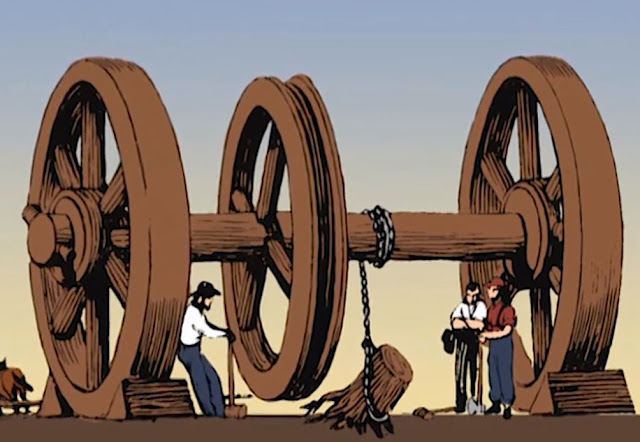 One thing that they did not mention was the labor saving stump puller in the picture. It stood 16 feet tall. The outer wheels were for moving the set-up. A rope to the stump was wrapped around the shaft. Another rope around the inner wheel went to a team of oxen (barely visible in the left corner). It made pulling stumps a lot easier.
It’s likely that Irish laborers were brought in on short term contracts from other states and Canada. You can find newspaper accounts from the day that mention Irish labor, such as the account of a Catholic-Protestant brawl among Irish canal workers in Lockport in 1824 (Ronald E. Shaw, Erie Water West, citing the Buffalo Patriot, July 20, 1824).
As far as deaths go, that’s tougher. I imagine there was little incentive to properly bury the dead, especially since the areas they were working in were sparsely populated. I suspect the men who contracted the laborers kept records so maybe that’s the source of the number.
The Erie Canal Museum staff would be the people to ask.
The state farmed out much of the actual construction of the original Erie Canal to contractors in each region. Typically those contractors would hire local people to do the actual work. I think that many of those workers were farmers or farm hands from the area. I have also read that Irish and Welsh men also did some of the work. If a local farmer died while constructing the canal, it might be difficult to determine that from his gravestone or any death record that might have been kept.
The stump puller that you show was apparently one of the devices that was invented by someone working on the canal, perhaps one of those local contractors. Digging a 363 mile long ditch by hand is a mind boggling task. When you realize that much of the route went through virgin forests, you can understand why many people thought that it could never succeed. The stump puller was one of the inventions that helped to prove them wrong.