The Erie Canal had it’s official opening 200 years ago (Oct. 26, 1825). New York State asked the Federal Government for aid in building the canal but no money came from the Feds. Instead, New York State paid for the entire build. It was such a success that it was paid for in just after a year.
The original canal was just 40 feet wide and 4 feet deep. Many people wonder why the canal didn’t go from Albany to Lake Ontario. Two reasons against that route. We had just finished a war with England (and their colony of Canada) in 1815. Second, it would be difficult to get above Niagara Falls.
 Rochester benefited greatly from the canal running through it. Rochester was just a sleepy little village before the canal. It grew so fast that Rochester became a city in 1834.
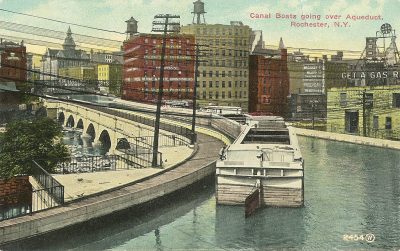
This postcard on the right shows boats going over the aqueduct that crosses the Genesee River. That aqueduct is still there as the base of the Broad Street bridge when the road was built over the top. That was because they re-route the canal in the early 1900s to south of Rochester.
Canal boats originally had horses or mules pulling them. The postcard is from the early 1900 when the barges were using motors.
Boats on the canal had to pay a toll based on the weight of their cargo. Some carried passengers but lists are VERY rare.
When the railroad started in the 1850s following the same route as the canal, they would cut into the canal’s business. Still it was far cheaper to use the canal for cargo. Most passengers would also take the canal because it far cheaper, especially if you had trunks with all your household goods.
Eventually in the 1900s the railroad would take most of the business of the canal. Yet, the canal is still there. Mostly used by pleasure boats. Every few years there is some cargo that is too large to go on the highway or railroad.
Just this year there was a man taking the “Grand Loop” trip. You can start from New York City and go up the Hudson River. Then the Erie Canal gets you to Lake Erie. Take the Great Lakes to Chicago where there is a canal that takes you to the Mississippi River. At New Orleans you follow the coast around Florida and back up to New York City.